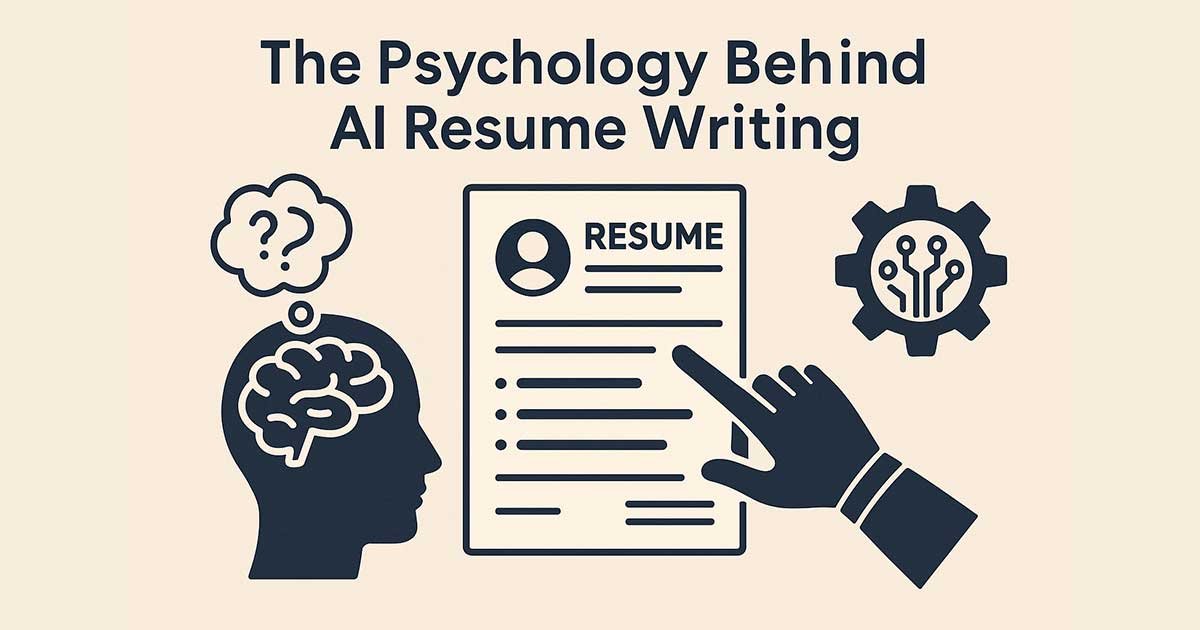
The Psychology Behind AI Resume Writing
In a world where recruiters scan hundreds of resumes in minutes, standing out isn’t just about having great experience — it’s about how your resume makes them feel. That’s where psychology meets technology.
With the rise of AI-powered resume builders, writing a resume is no longer just a formatting task. It’s a data-driven psychological strategy, designed to capture attention, build trust, and spark emotional connection — all while passing ATS filters.
Let’s explore the fascinating psychology that drives AI resume writing and how you can use it to create a resume that connects with both humans and machines.
Must Read – How AI Can Personalize Your Cover Letter for Each Job (2025 Guide)
🧠 1. Understanding the Psychology Behind First Impressions
Recruiters form their first impression within 6–8 seconds of viewing your resume. AI tools understand this and are trained to optimize resumes for:
Visual hierarchy: Placing key information (skills, titles, metrics) where the eye naturally lands first.
Cognitive fluency: Using clean layouts and consistent spacing to reduce reading strain.
Emotional tone: Adjusting word choice and phrasing to feel confident, trustworthy, and human.
When you use an AI resume builder, it applies psychological research on eye-tracking and cognitive processing to design resumes that instantly feel professional and easy to navigate.
💬 2. The Language of Persuasion
Good resumes aren’t just informative — they’re persuasive.
AI models trained on successful resumes analyze tone, phrasing, and word power to make your content sound confident but not arrogant.
Here’s how AI leverages psychology in wording:
| Psychological Principle | How AI Uses It in Resume Writing | Example |
|---|---|---|
| Social Proof | Highlights achievements validated by numbers or teams. | “Led a team of 8 engineers to increase efficiency by 25%.” |
| Authority Bias | Positions you as credible through strong verbs and titles. | “Managed, Directed, Spearheaded” instead of “Did” or “Helped.” |
| Recency Effect | Prioritizes the latest and most relevant accomplishments. | Lists recent projects or achievements first. |
| Loss Aversion | Emphasizes how you prevented or reduced problems. | “Reduced system downtime by 30%.” |
This blend of neuro-linguistic writing and data-backed phrasing makes AI-generated resumes psychologically appealing — to both human recruiters and ATS systems.
🧩 3. Storytelling Through Data
Humans are wired to respond to stories. But a resume doesn’t give much space for narrative — which is where AI storytelling logic comes in.
Modern tools like Teal, Kickresume, and Rezi use algorithms that mimic storytelling patterns:
Challenge: What problem or situation did you face?
Action: What did you do to solve it?
Result: What measurable outcome did it create?
This “CAR framework” turns your bullet points from simple tasks into mini success stories that trigger emotional engagement.
For example:
❌ “Responsible for managing marketing campaigns.”
✅ “Led 5 marketing campaigns that grew website traffic by 160% in 4 months.”
That’s AI-powered storytelling — data presented in a psychologically compelling way.
🎨 4. The Visual Psychology of Resume Design
AI resume builders don’t just write — they design intelligently.
They apply principles of color psychology, spacing, and layout aesthetics to improve readability and recruiter engagement.
Here’s what AI knows about design psychology:
White space = calm + professionalism
Subtle color accents (like blue or slate gray) = trust & clarity
Consistent alignment = organization & confidence
Bold section titles = faster scanning
That’s why modern AI tools automatically test different layouts to see which one gets higher recruiter engagement rates.
They know that a well-designed resume feels more credible, even before anyone reads a word.
Also Read – 10 Best Free AI Resume Builders in 2025
⚙️ 5. Emotionally Intelligent Writing (EI + AI)
AI has grown smarter — it doesn’t just understand words; it understands emotion.
With emotional intelligence (EI) training datasets, tools like ChatGPT, Jasper, and Teal can adapt tone and personality to match industry expectations.
For instance:
For a corporate finance job → AI writes formally with structured, authoritative tone.
For a creative design job → It uses expressive, conversational language.
For a startup environment → It adds energy and enthusiasm.
This tonal adaptability gives your resume a psychological “mirror effect” — it feels familiar and aligned with the company’s voice, increasing emotional resonance.
🧮 6. The Cognitive Bias Behind Keyword Optimization
Most recruiters use ATS (Applicant Tracking Systems) that filter resumes by keywords.
But did you know keyword use also taps into cognitive bias?
When recruiters see specific, role-aligned words — like “project management,” “data analytics,” or “strategic growth” — their brain triggers pattern recognition, reinforcing trust and competence.
AI resume builders study thousands of job listings to find keyword clusters that create this recognition effect, subtly guiding the recruiter’s mind toward positive impressions.
It’s a psychological trick wrapped in an algorithm — and it works.
🔍 7. Personalization and the “Mirror Neuron Effect”
Humans naturally trust those who reflect their own tone, goals, or energy — a neurological process known as the mirror neuron effect.
AI resume tools now use this principle to personalize resumes that mirror the company’s communication style.
If a job description says,
“We’re looking for a creative thinker who loves solving complex problems,”
AI mirrors that tone:
“A creative thinker passionate about tackling complex challenges with innovative solutions.”
This psychological mimicry makes your resume feel instantly relatable and aligned with company culture.
🔄 8. The Power of Simplicity (Cognitive Ease)
Resumes overloaded with text or design are mentally exhausting.
AI applies the principle of cognitive ease — the simpler something is to read, the more trustworthy it feels.
So AI tools automatically:
Break long sentences into bullet points
Use consistent formatting
Limit jargon and redundancies
Prioritize readability across devices
This simplicity not only pleases the eye but also reduces recruiter fatigue, helping them retain more about you.
⚡ 9. The Feedback Loop: AI Learning From Human Behavior
The newest AI resume platforms are not static — they learn from recruiter reactions.
For example, Teal and Rezi analyze user feedback, application outcomes, and recruiter engagement data to refine what kinds of resumes perform best.
This continuous learning creates a psychological evolution — AI resumes are getting better at understanding what feels right to both recruiters and employers.
🏁 10. Balancing AI and Authenticity
The biggest psychological rule of all?
Humans connect with authenticity.
AI can optimize tone, structure, and flow — but your unique story, passion, and achievements are what truly make your resume stand out.
So always:
Review and personalize your AI-generated resume.
Add genuine examples and metrics.
Keep your voice consistent.
When AI provides the structure and you add the soul, the result is a resume that appeals to both algorithms and emotions.
📈 Best AI Resume Tools That Use Psychological Design
| Tool | Strength | Psychological Edge | Free Plan |
|---|---|---|---|
| Teal | Job-specific keyword matching | Behavioral tone mimicry | ✔️ Yes |
| Kickresume | AI-powered writing + design | Storytelling-based achievements | ✔️ Yes |
| Rezi | ATS & recruiter-friendly | Data-driven confidence phrasing | ✔️ Free tier |
| Canva AI | Visual design focus | Color & layout psychology | ✔️ Yes |
| ChatGPT (Custom GPTs) | Custom narrative crafting | Emotional tone adaptability | ✔️ Yes |
✅ This table is Classic Editor and mobile compatible — it stacks smoothly on phones.
🧭 Final Thoughts
AI resume writing is no longer about automating words — it’s about understanding the human brain behind the hiring process.
By combining cognitive psychology with natural language processing, AI creates resumes that are logical, emotional, and visually optimized all at once.
The key is balance:
👉 Let AI handle structure and optimization, but make sure you infuse it with your personality.
Because no matter how advanced AI becomes, the most powerful connection on your resume will always be human.